Upcoming Events
Menu




Greece struck again in the RS3 of the 27th Rallye Monte-Carlo Historique, on Saturday afternoon, as a new crew, also in a Fiat 128 Rally, took over from their compatriots and won the stage between La Piarre and Valdrôme (13.7km) with flying colours. Aris Georgosopoulos and Ioulios Iatridis only took 40 penalty points in this stage, which was snow-covered on the uphill section and then very wet on the downhill section, but without any icy patches.
This stage also did the trick for the rally’s absolute benchmark in the ‘medium-low’ category, Belgians Michel Decremer and Jennifer Hugo in a 1965 Alfa Romeo Giulia TI, two-time winners of the RMCH (2017, 2024). Behind the Fiat and the Alfa, the places of honour were taken by Schön-Giammarino, 3rd in their Austin Mini Cooper S. Behind them, multi-starred chef Michel Chabran (BMW 323i) was a joint 5th, ahead of his son Louis (BMW 1602) to whom he handed over the running of his gourmet restaurant in Pont-sur-l’Isère.
In the very provisional overall classification, before the last stage of this first day of racing, the Decremer-Hugo tandem, as formidable as ever, was in the lead, ahead of the two Greek Fiat 128 Rallye crews (2nd and 3rd), the Jaguar Mk2 3.8 of Karolis Raysis and Ovidijus Meilunas (4th), the Mini Cooper of the Italian crew (5th) and the Ford Capri of Bruno Saby (6th). But anything was still possible, including a complete shake-up of the standings after the RS4 at the end of the day…
On the road of the Rallye Monte-Carlo Historique, episode 1 – For the 27th edition, entry was open to cars that had competed in the event between 1911 and 1983. In the end, 219 cars were allowed to take part, including the oldest, a Sunbeam Alpine. James Pohl and Joyce Mordenti are in for the second time on the roads that have written the legend of the event, with their 1953 car.
It’s not the most powerful, nor the sportiest. But there’s no denying that this old-timer is reallycharming and must intrigue a good number of enthusiasts who came to admire the cars entered in this 2025 Rallye Monte-Carlo Historique. The Sunbeam Alpine, number 224, which set off from Monaco on Thursday evening in the pouring rain, is officially the doyenne of this 27th edition.
James Pohl, a.k.a. Jim, and Joyce Mordentin are no strangers to this car, which was completely rebuilt in the 90s by Joyce’s father, “an amazing mechanic”. Last year, they had already set out to conquer these roads and this legendary course. But the hard law of Monte Carlo had struck. “We started in Reims, and we broke down in the middle of the night of the Concentration Leg”, recalls the American driver, still marked by his first experience.
Their tenacity paid off in the end: after an express return trip to Yorkshire, England, to collect spare parts, Jim Pohl was able to repair his white Sunbeam Alpine and set off for Valencia. He adds: “We talked to the officials, and said ‘Please, can we just drive? We know we are dead last; we don’t care about winning, we want to participate’.”
A princely meeting
Crew 178 eventually reentered the race and managed to get to Monaco, their original target. Already very happy to have reached the Principality, Jim Pohl and Joyce Mordenti were not at the end of their surprises. “H.S.H. Prince Albert II of Monaco wanted to meet us because the Sunbeam Alpine is the same kind of car that his mother, Princess Grace, drove in the film To Catch a Thief. His father, Prince Rainier III, also drove one a lot.”
For 2025, there’s no question of taking revenge, but neither do the pair dream of emulating their hero, Sheila Van Damm, winner of the Coupe des Dames on the Rallye Monte-Carlo in 1955 in a Sunbeam MK III with Anne Hall. Jim Pohl and Joyce Mordenti agree: “This year, we just want to drive every mile on the Rallye Monte-Carlo Historique! We do not want to break down again.”
The good news is that the Parcours de Concentration went well for the seven-decade-old Sunbeam Alpine. Crew 224 arrived at the Place du Champs-de-Mars on Friday afternoon, along with 215 other competitors. Before tackling the Classification Stage 1 this Saturday, with the first four regularity stages.
A 1976 Porsche 911 Carrera, driven by Irishman Paul Okane and co-driven by Danish driver Tage Gelj, won the second regularity stage of the 27th Rallye Monte-Carlo Historique on Saturday, between Les Nonnières and Chichilianne (SR2, 16.3km). Behind this pairing, and in wintery and treacherous conditions, a venerable 1978 Saab 96, with a Lithuanian crew on board, took 2nd place in this RS2, tied with the Fiat 128 Rally of the Greek crew which had won SR1.
It was another beautiful stage, in wintery temperatures and with lots of people lining the road. It was a stage in which Bruno Saby, at the wheel of his Ford Capri bearing number 38, that of the Isère department, once again showed the tip of his nose. The winner of the Monte Carlo Rally in 1988, in a Lancia Delta HF, had already taken 8th place in SR1, and he did slightly better: tied 5th in RS2, thanks to his talent as a driver and the obvious qualities of his 1970 Ford Capri 2300 S. After the morning stages, Saby’s Capri was 3rdoverall.
Incidentally, it was the first win for a Porsche in this 2025 edition of the RMCH, given that 81 German cars took the start in Valence on Saturday morning, the majority of them Porsches. Three retirements were recorded on Friday in the German ranks, those of an Opel Kadett and two Porsches, on the route of the Concentration Leg to Valence. In this armada of six major makes (Porsche, Volkswagen, Opel, BMW, Audi and Mercedes), the Porsches are by far the cars best suited to a Rallye Monte-Carlo Historique in winter conditions, those of the start of this 2025 edition.
In the overall classification, and before the two afternoon stages (SR3 and SR4), there was a total surprise with a pair of Greek leaders, Georgios Alevizopoulos and Nikolaos Palyvos, in a Fiat 128 Rally, ahead of all the favourites. But not the Ford Escort RS2000 of Dane Henrik Bjerregaard and Czech Jaromir Svec, winners of the RMCH in 2022. The number 2 Ford was trapped on the uphill section of this RS2 and had to retire. The rally is still a long one, and a lot was meant to happen this afternoon before the return to Valence for a healthy dinner and a well-deserved night’s rest.
The first regularity stage of the 27th Rallye Monte-Carlo Historique, between Col Gaudissart, the entry point into the Massif du Vercors, and Cîme du Mas, just outside La-Chapelle-en-Vercors (SR1, 18.1km), started as scheduled at 9.20am on Saturday morning for the 215 crews who had checked in Valence on Friday (out of the 219 who started on Thursday from four cities, Monaco, Reims, Bad Hombourg and Turin). And it enabled two small cars, an Austin Mini Cooper S and a Fiat 128 Rallye, to beat all the big ones.
The first winning team of this 27th edition is not made up of unknowns. It is the Mini Cooper team of Italians Giorgio Schon and Francesco Giammarino, led by Giorgio, an endurance driver in his younger days. The Fiat team was 100% Greek, made of Georgios Alevizopoulos and Nikolaos Palyvos. They finished tied with the Italians, with only a 100-point penalty score on this RS1, quite a performance. At the other end of the standings, the car ranked 215th in this stage, a Porsche 911, took 30,000 penalty points over 18 km. But they made it to the finish!
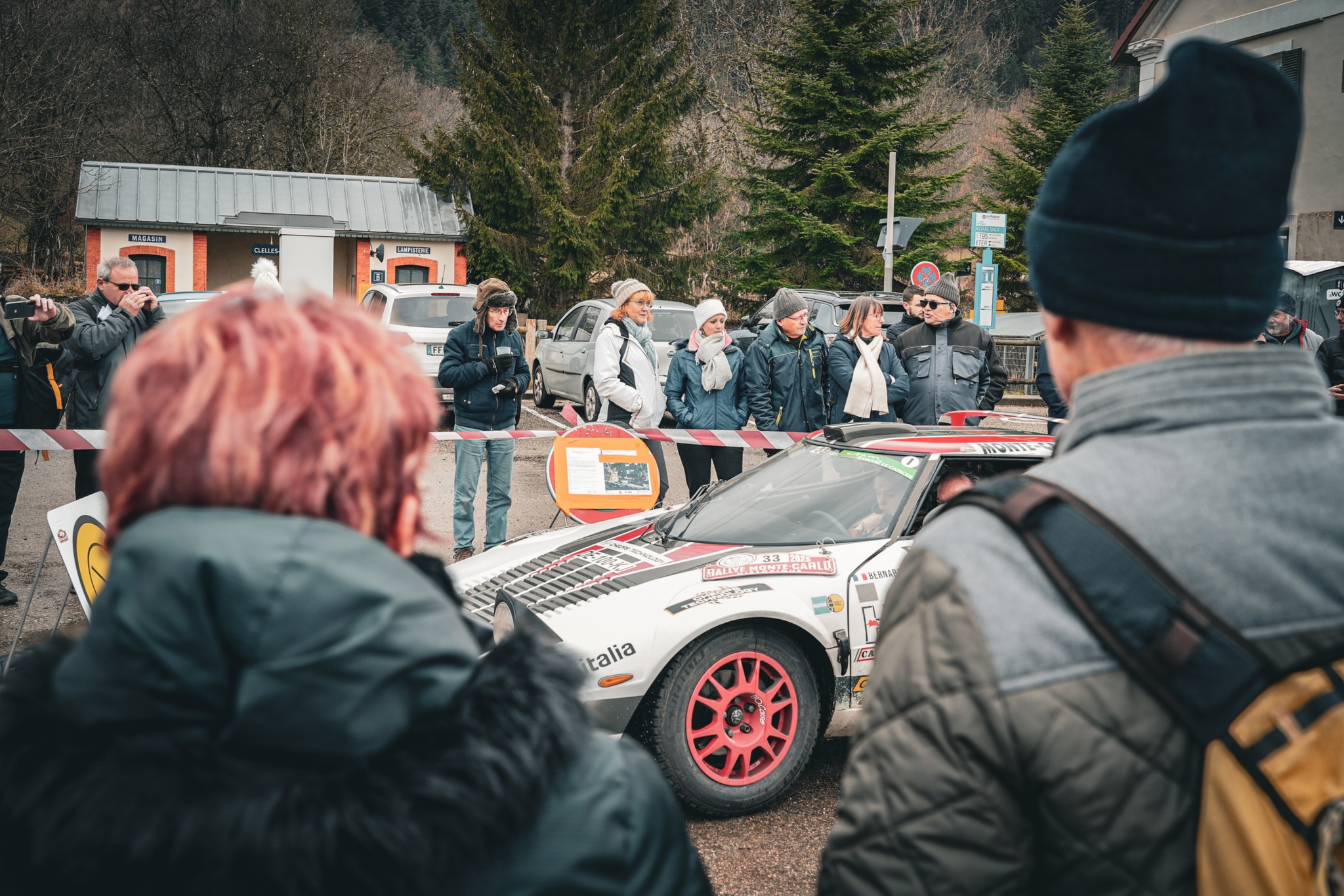
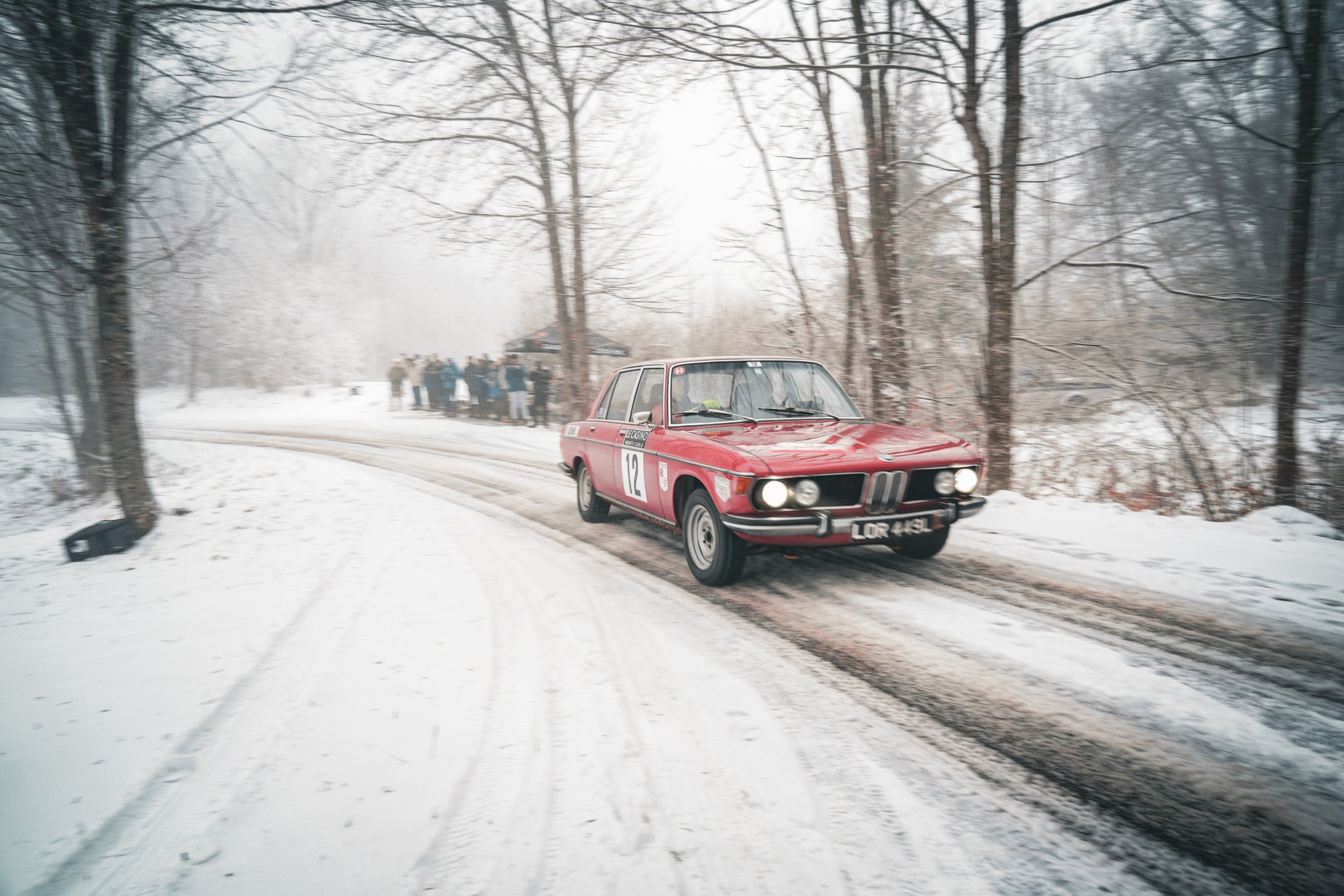
This first RS1 in the Drôme (out of 17 scheduled until Tuesday evening) was covered in heavy snow in places (totally from km 2 to km 7, then partially from km 7 to km 15), and the ambient temperature at the start of the morning was just below 0°C. As a direct consequence, the many Porsche drivers of all ages (the drivers and the cars!), all equipped with a rear engine, had a lot of fun, while delighting the many spectators who braved the cold to get to the sides of this stage. The long drifts in slow motion, for fun, particularly on Col de l’Echarasson, can all be used as promotional videos for Rallye Monte-Carlo Historique, the most legendary event of all.
Out of 219 crews authorized to take part in the 27th Rallye Monte-Carlo Historique (RMCH), 215 cars arrived in Valence on Friday afternoon, and perfectly parked on Champ de Mars in the heart of the Drôme capital. Some had set off from Monaco, others from Bad Homburg in Germany, Torino and Reims. They had to cover between 400 and 800 km, depending on their starting city, and had to pass a number of compulsory checkpoints on the concentration route chosen by their crew.
The first car arrived in Valence just before 1pm. The Ford Escort RS2000 (1979) of Dane Henrik Bjerregaard and Czech Jaromir Svec, winners of the RMCH in 2022. They had set off from Monaco at 7pm on Thursday evening, with race number 2 on the doors. They were therefore the first to be fitted with their Tripy-R, the electronic box with GPS and timing that will enable the organisers, in the control room of the Automobile Club de Monaco (ACM), to record their performances and above all their averages on the 17 regularity stages (SR) on the very tough menu of this 2025 edition.
All the other cars entered then lined up at the entrance to the Parc Fermé. Finally, as the sun set over the Drôme, everyone but four cars had checked in, including the 1959 Austin Healey that had travelled all the way from Germany, and the Alfa Romeo Giulia TI of the two-time Belgian winners (2017, 2024), Michel Decremer and Jennifer Hugo, who left Reims on Thursday evening with the number 200.
Streaming on Champ de Mars
From 3pm onwards, the ACM streamed the arrival of the competitors live on its YouTube channel, with on-site commentary in minute detail by Alexandre Khaldi, the well-known motorsport presenter, and Gerry Mestre, Chairman of the ACM Historic Car Commission. It was a sequence that was closely followed by all regular ACM followers on the social networks as they awaited the start of the first part of the Classification Event at 7.30am on Saturday morning. The four regularity stages will provide an opportunity to sort out the former winners, the new contenders and some genuine rally champions, such as Frenchman Bruno Saby, Italy’s Maurizio Verini, Spain’s Luis Climent Asensio and American John Buffum, among several big names in this 27th edition.
Everything that happens on the roads of the Drôme and Ardèche, in the villages of Isère and Vercors, will be reported in real time on the official website and social networks of the ACM until the grand finale on Tuesday evening on Col de Turini, shortly before midnight. The next stream is scheduled for Sunday at 3pm in the village of Saint-Bonnet-le-Froid, in the heart of Haute-Loire. The line-up for this Rallye Monte-Carlo Historique has never been better, spicier or more exciting, a bit like the cuisine in many restaurants, Michelin-starred or not, of the beautiful host-city of Valence. More than ever the rally’s operational HQ, where crews will return on Saturday evening after a great day’s driving.
A prestigious field of 219 crews and 34 makes has been authorised to start the 27th Rallye Monte Carlo Historique (RMCH) this Thursday. This rolling festival of classic racing cars, which runs until Tuesday evening, is reserved for models that took part in Rallye Monte-Carlo between 1911 and 1983. It will be followed by thousands of fans in the 500 cities, towns and villages it passes through, and often alongside the 17 regularity stages (SR) on which competitors will attempt to respect a high or low average speed set by Automobile Club de Monaco (ACM).
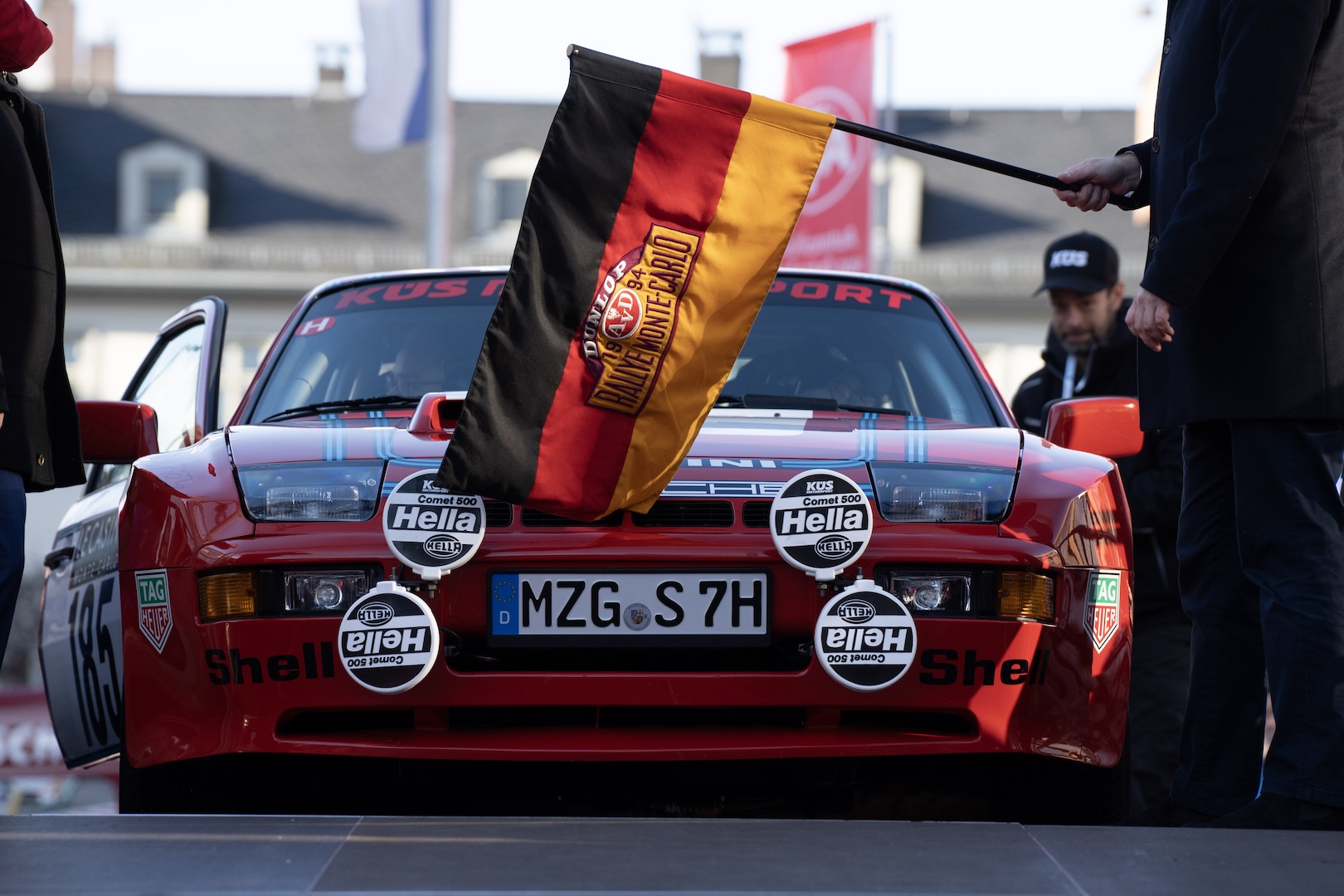
In detail, there were 16 competitors in Bad Homburg, near Wiesbaden and Mainz, at 2pm on Thursday. They all had 870 km to cover on the concentration route to Valence, via Langres, Dole and Bourgoin-Jallieu (on the outskirts of Lyon). A number of competitors in Porsches, Volkswagens and Opels logically chose to start from Germany, as did the driver of an old 1959 Austin Healey, Norwegian Christian Hallan.
Ford in Monaco…
Then, four hours later, there were 86 starters in Monaco, under the rain. They had just over 20 hours to cover 430 km, with compulsory checkpoints (Saint-André-les-Alpes, Gap, Die, Crest) until Friday afternoon’s check-in, from 3pm onwards, on Place du Champ de Mars in Valence, the host-city for this 27th edition.
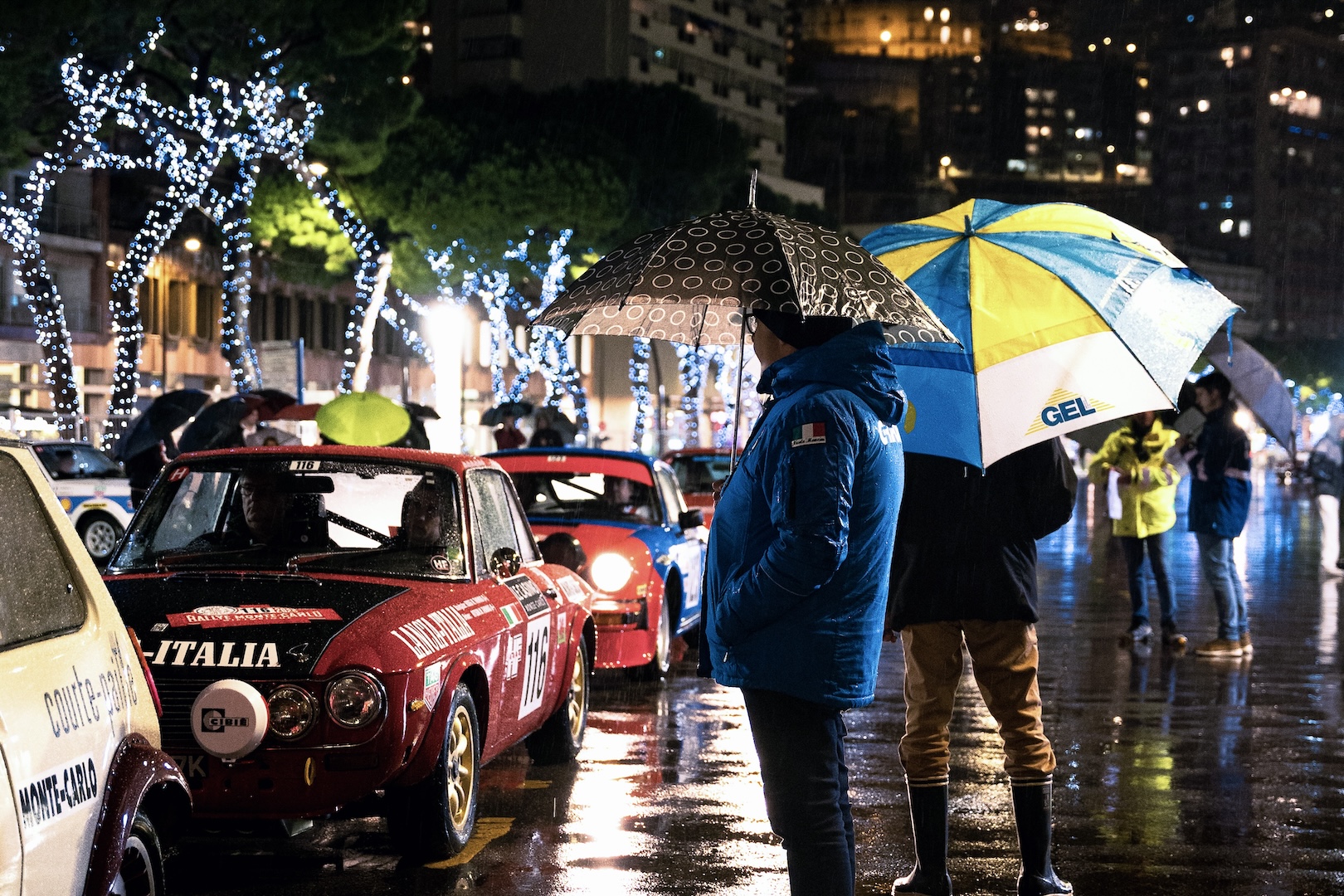
Monaco was not a starting town last year, but the destination of all the concentration routes, including those of Glasgow and Milan, which are not on the programme for this 2025 edition. Among the notable competitors at the start in Monaco were Henrik Bjerregaard and Jaromir Svec, winners of the RMCH in 2022, in a 1979 Ford Escort RS2000. There was also Sébastien Chardonnet, a former WRC3 world champion, in another Ford Escort, as well as Bruno Saby, the 1988 WRC winner of Rallye Monte-Carlo, in a Lancia Delta HF. Like last year, he set off again in a superb Ford Capri, still bearing the number 38, a tribute to his home region of Isère. Not forgetting Michelin-starred chef Michel Chabran, in a 1979 BMW 323i.
Lancia in Torino…
By 7pm, 52 drivers were due to start in Torino, including the number 1 contender and president of the Automobile Club d’Italie (ACI), Giovanni Sticchi Damiani, in a 1975 Lancia 124 Abarth. The ACI is the historic organiser of the Formula 1 Italian Grand Prix, held in the temple of Monza, and of the formidable Rally di Sardegna, which counts for the WRC World Championship, among other events, both current and historic, masterfully organised by President Damiani and his team. In another legendary Italian car, recent Swiss winners Claudio Enz and Cristina Seeberger (2023) took the start in their faithful Lancia Fulvia Coupe 1.3 s from 1970.
The 2024 winners in Reims…
In this year’s rally, 34 different automobile manufacturers are entered and 219 crews, including seven 100% women, have been authorised to take the start, representing 25 nationalities, Reims played a large part in the celebrations, this year again, and 65 perfectly prepared cars, also from 7pm, took it in turns to parade down the start ramp. These included the title holders, Belgians Michel Decremer and Jennifer Hugo, who swapped their Opel Ascona 400 from last year for a 1965 Alfa Romeo Giulia TI.
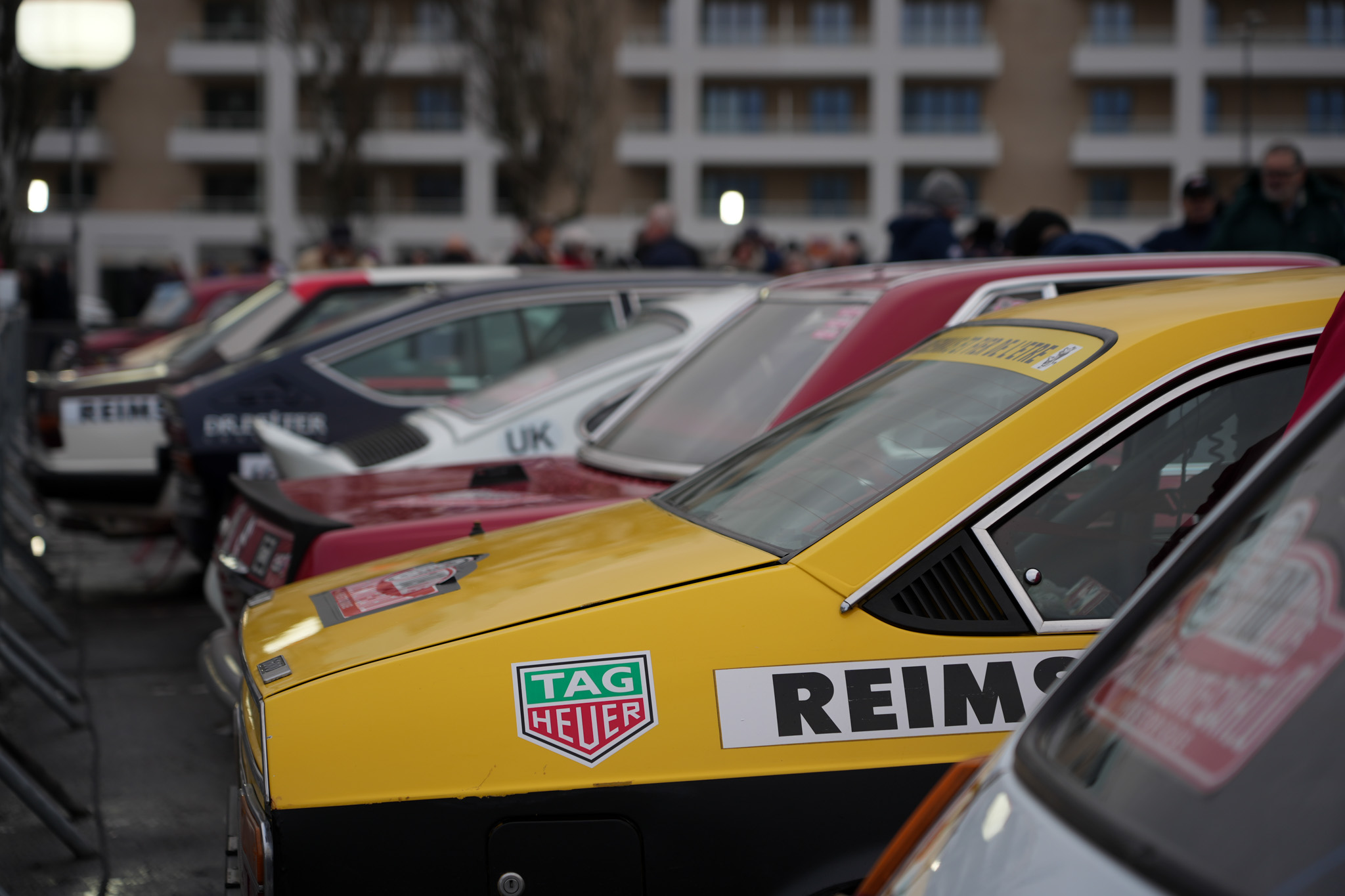
All these popular starts on Thursday were made possible by the involvement of volunteers from the German and Italian Automobile Clubs, the ever-dynamic Reims Champagne Véhicules Historiques Sportifs association and all the ACM’s special correspondents. From Saturday onwards, there will be hundreds of kilometres to cover, right up to the final stage on Col de Turini, next Tuesday evening. The aim is always the same: to try and respect the high or low averages calculated and imposed by the ACM, while having fun and not taking too many risks. Once again, given the quality of the field, the suspense will be total, right to the end, and the show will be a success, for thousands of nostalgic fans!
Just four days after the finish of the 93rd Rallye Monte-Carlo in its modern version (WRC), and thus the 10th victory (an all-time record) for Sébastien Ogier, in a Toyota Yaris, the 27th Rallye Monte-Carlo Historique offers a fascinating journey into the past, starting on Thursday: 220 crews in cars from 34 different makes, even if some of them are now part of the same group. As usual, the route will include a majority of regularity stages (SR) where legend has been written for almost a century. And with a Concentration Leg to start with, just like in the old days.
On Thursday, four host-cities will welcome the 220 crews from all over Europe, including the Baltic States, from Ukraine, Switzerland and the United States (25 nationalities represented in all) for a symbolic, old-fashioned start. There will be 16 cars on the starting ramp in Bad Homborg (Germany) from 2pm, then 65 in Reims and 86 in Monaco from 6pm, and finally 53 in Turin from 7pm, including the President of Automobile Club d’Italie, Giovanni Sticchi Damiani, with number 1 on the doors of his venerable 1975 Lancia 124 Abarth.
Their common destination? Place du Champ de Mars in Valence, prefecture of the Drôme department and traditional headquarters of the rally, which the first competitors will reach on the afternoon of Friday 31 January. On the entry list for this 2025 edition, there are five crews with former winners, starting with Belgium’s title holders Michel Decremer and Jennifer Hugo, who have swapped their Opel Ascona 400 from last year for a 1965 Alfa Romeo Giulia TI. They will be setting off from Reims with the number 200, rather than the number 1 to which they were entitled. There is a good reason for this: they’ve taken the incredible gamble of setting off at the end of the pack, with lower speed averages to respect in the regularity stages. Which is known to be almost impossible to achieve, if you want to be the overall rally winner…
Several former winners…
The other former winners entered this year are Henrik Bjerregaard and Jaromir Svec (2022), in a 1979 Ford Escort RS2000, Claudio Enz and Cristina Seeberger (2023) in a 1970 Lancia Fulvia Coupé, and three-time winner José Lareppe (2010, 2012, 2014), co-driver of his son Patrick in a 1975 Opel Ascona. As for Sébastien Chol, Ludovic de Luca’s co-driver in a small 1976 Peugeot 104 ZS, he won the 2013 edition in Gérard Brianti’s right-hand bucket.
In terms of big names and long lists of victories, this 27th edition of RMCH is really packed to the rafters. Judge for yourself: Luis Climent Asensio (BMW 323i, 1981), Spanish Rally Champion in 1996; Raymond Durand (Opel Kadett GTE, 1977), two-time winner of Rallye Monte-Carlo des Energies Nouvelles (2009, 2011); Maurizio Verini (Alfa-Roméo Giulietta, 1982), European Rally Champion in 1975. As for American John Buffum, another living legend (Ford Escort RS2000, 1980), another living legend, he collected 11 crowns of USA Rally Champion. Another authentic champion is Sébastien Chardonnet (Ford Escort 2000, 1981), the son of former Lancia importer in France who entered Bernard Darniche’s blue Stratos that won Rallye Monte Carlo in 1979. Sébastien won the world title in the WR3 category in 2013. And while we’re on the subject of Lancia, how could we fail to mention that Bruno Saby is back, as he was last year, at the wheel of a 1970 Ford Capri 2300 S. Bruno won Rallye Monte Carlo Rally in 1988, in a Lancia Delta HF that everyone remembers, flying the colours of Martini Racing.
VIPs and legendary cars…
Several VIPs will also be at the start on Thursday, as well as 7 female crews. Former Michelin-starred chef Michel Chabran, who has passed the baton to his son Louis, now has time to take part in Rallye Monte-Carlo Historique, so he’ll be making the most of it, at the wheel of a 1979 BMW 323i, partnered by Jules Chabran. Olivier and Lydia Campana (VW Golf GTI, 1979) have been awarded the ACM Cup several times, reserved for the best-placed Monegasque crew. And Jean-Marc Finot, the director of Stellantis Motosport, is taking over from his former CEO, Carlos Tavares, to defend the colours of his group at the wheel of a 1973 Alfa Romeo 2000 GTV Coupé, in partnership with Xavier Pontheaux.
As this is a Historic Monte-Carlo Rally, the list of 34 makes represented is impressive is enough to encourage spectators of all ages to flock to the roadsides, anywhere on the route. As well as a myriad of Lancia cars, in keeping with the winning Stratos on the official poster (the one driven by Sandro Munari in 1977), there will be a myriad of cars belonging to the sporting history of Porsche, Alfa-Romeo, Opel, Renault, Alpine, Volkswagen, Fiat, BMW and Mini, to name a few. A must-see for all enthusiasts!
As every year, Valence, the capital of the Drôme region, will be the rally HQ until the start for Monaco on Tuesday. And many of the towns and villages, in the numerous départements it passes through, will be organising particularly festive buffets or tea parties. Including the concentration route, the rally will pass through almost 500 towns and villages. Let the festivities begin!
Ask for the programme!
Saturday 1st February, Classification Leg, Part 1:
Sunday 2 February, Classification Leg, Part 2:
Monday 3 February, Common Leg, Part 1:
Tuesday 4 February, Common Leg, Part 2:
Return to Monaco – Start of the Final Leg at 9 pm:
Wednesday 5 February:
Following the publication of the pre-regulations at the beginning of September, the Organizing Committee of the 27th Rallye Monte-Carlo Historique is pleased to announce that the 2025 Supplementary Regulations for the event are now available online.
Download the supplementary regulations
You have until Monday, November 11, 2024 to register. Until then, enjoy reading it…
Le règlement particulier du 𝗥𝗮𝗹𝗹𝘆𝗲 𝗠𝗼𝗻𝘁𝗲-𝗖𝗮𝗿𝗹𝗼 𝗛𝗶𝘀𝘁𝗼𝗿𝗶𝗾𝘂𝗲 2025 est en ligne ! 📖
🚨 Il est encore temps de vous inscrire sur le site https://t.co/MBgWmFCuYG pour participer 🤩#RallyeMonteCarloHistorique pic.twitter.com/e4UHIb3gGf
— Automobile Club de Monaco (@ACM_Media) October 9, 2024
Year after year, Rallye Monte-Carlo Historique continues to stand out for the diversity and authenticity of its route. The Organising Committee of Automobile Club de Monaco (ACM) wanted the 2025 edition to be even more attractive with, as usual, a majority of Regularity Stages (RS) that have helped writing the event’s great history! And there is no doubt that many more competitors will be battling it out for overall victory, in a bid to dethrone Michel Decremer and Jennifer Hugo, winners of the 2024 event in their 1979 Opel Ascona 400.
As usual, the historic version of Rallye Monte-Carlo is reserved to cars that took part in former editions of Rallye Automobile Monte-Carlo, and next year to models having raced between 1911 and 1983. The 2025 event is scheduled to kick off on Thursday January 30, just four days after the finish of the 93rd Monte Carlo Automobile Rally. The competitors authorised to take the start of this 27th edition of Rallye Monte-Carlo Historique will set off successively from Bad Homburg, Reims, Monte-Carlo and Turin. Their common destination is Place du Champ de Mars in Valence, the prefecture of the Drôme department and a traditional stopover town, which the first competitors will reach on the afternoon of Friday January 31.
The first four regularity stages are scheduled for the following day, Saturday February 1, included in a Classification Leg (with the first competitor starting at 7:30am). This first day of the race will not be a restful one for the competitors, however, starting with a classic of the Vercors massif: Col Gaudissart – La Cîme du Mas / SR 1 / 9:20am and its atypical Col de l’Écharasson (1146 m). Then on to Les Nonnières – Chichilianne / SR 2 / 11:20am and its dreaded Col de Menée (1402 m) before the mid-day time check organised in Clelles, home of the rally in the Dauphiné area, from 12:00. The next stage will be La Piarre – Valdrôme / SR 3 / 1:20pm, including the crossing of Col de Carabès (1261 m), the natural border between the Hautes-Alpes and Drôme departments. Back to “Drôme Provençale” to finish the day with La Motte-Chalancon – Saint-Nazaire-le-Désert / SR 4 / 2:30pm via Col de Chamauche (1037 m). A final time check is scheduled in Crest at 4:00pm, to regulate the competitors expected at Champ de Mars in Valence from 4:55pm.
Competitors will head for Ardèche on Sunday February 2 at 7:30am for Part 1 of the Common Leg. They will first have to reach Privas for a time check (8:45am) before starting the day with the new Saint-Julien-du-Gua – Col des Quatre Vios / SR 5 / 09.25am. This will be followed by a welcome stop-over on the road, in Vals-les-Bains, as in the old days. Next will come the classic version of Burzet – Saint-Martial / SR 6 / 11:35am via the Ray-Pic waterfall. The mid-day break is scheduled on Market Square in Saint-Agrève from 1.15pm, where competitors and friends will enjoy a tasting of local produce, before continuing with a new stage Saint-Bonnet-le-Froid – Vanosc / SR 7 / 1.40pm followed by Saint-Pierre-sur-Doux – Lalouvesc / SR 8 / 3.10pm. The return to Valence (5:30pm) is once again preceded by a traditional popular and festive stopover on Quai Farconnet in Tournon-sur-Rhône from 4:45pm.
Heading for the Vercors, Diois and Baronnies massifs is the plan for Monday February 3 at 7:30am for Part 2 of the Common Leg. The longest day of the rally will begin with the ascent of Col de Tourniol (1145m) between Barbières – Gigors-et-Lozeron / SR 9 / 8:35am. The difficulties will increase with the next stage, Saint-Nazaire-le-Désert – Chalancon / SR 10 / 10:40am, taking competitors over Col de Muse (932m), Col de Chamauche (1037m) and Col de la Croix (722m). The mid-day break is scheduled in Buis les Baronnies at 12:45pm, before the longest stage of the rally, Montauban-sur-l’Ouvèze – Roussieux / SR 11 / 1:25pm, covering some 40km and including Col de Perty (1302m), Col de Reychasset (1052m) and Col de Pierre-Vesce (1013m). The final difficulty on this leg will be Recoubeau-Jansac – Pennes-le-Sec / SR 12 / 3:00pm and the crossing of Col de Pennes (1040 m). The last stop of the day before the return to Valence (5:15pm)will be set, as on the previous day, on Place du Champ de Mars in Crest, with a time check from 4:20pm.
On Tuesday February 4, the start from Valence is scheduled for 7am. This 3rd and final part of the Common Leg will begin with La Charce – Rosans / SR 13 / 9am and its Col de Pommerol (1072m). The stage continues with “Sisteron – Thoard / SR 14 / 10h40” and its anthological Col de Fontbelle (1304m). Finally, to complete the descent to the Principality of Monaco, the remaining competitors will head for Briançonnet – Entrevaux / SR 15 / 2pm, with Col du Buis (1196m) and Col de Félines (926m) on the cards. Entry into Parc Fermé in Monaco will be scheduled from 4:20pm onwards, preceded by a time check at La Turbie from 3:55pm.
The start of the Final Leg, scheduled for the night of Tuesday February 4 to Wednesday 5, will take place in Monaco from 9pm. On the menu for this final night are two legendary stages of the Monegasque event, including Col de Braus – Lantosque / SR 16 / 10:15pm, with no fewer than four passes on the way, including Col de l’Ablé (1149m), Col de l’Orme (1005m), Col Saint-Roch (990m) and Col de la Porte (1057m). Last and not least, the last confrontation will happen between La Bollène-Vésubie – Moulinet / SR 17 / 11:25pm including, as a judge of peace, the majestic Col de Turini (1607m). The race is due to finish in Monaco’s Port Hercule from 1:10am.
Finally, in keeping with tradition, the Gala Evening and Prize Giving Ceremony will take place on the evening of Wednesday February 5 in the prestigious Salle des Etoiles at Monte-Carlo Sporting Club.
Note: Legs, Stages, Stage lengths and timings are given as an indication until official publication of the itinerary.
Everything came together to make this 26th Rallye Monte-Carlo Historique a great vintage, from the perfect weather to the quality of the organisation by Automobile Club de Monaco, from the welcome given by the locals in all the towns and villages along the route, to the very high standard of the 233 crews who set off from the four corners of Europe. In the end, it all came down to a superb winning duo, the Belgians Michel Decremer and Jennifer Hugo, in a 1979 Opel Ascona 400, who led the way from Saturday afternoon until midnight on Tuesday, without interruption.
The winning tandem from the Low Countries has every reason to be proud: the one and only time an Opel has triumphed in a Rallye Monte-Carlo was back in 1982 in an Ascona, with the great Walter Röhrl at the wheel, assisted by the faithful Christian Geistdorfer.
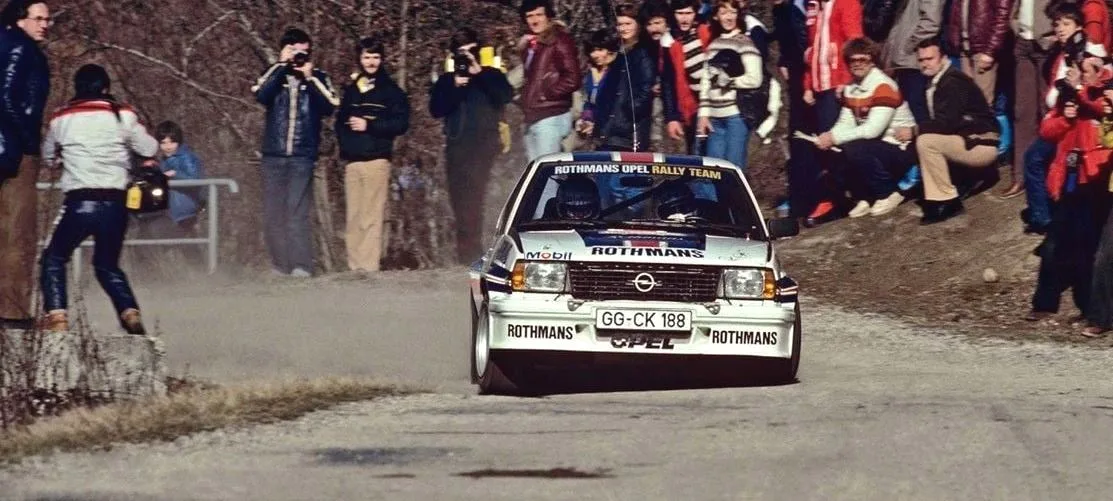
Michel Decremer, who had already won here in 2017 in an Opel Ascona 2000, and his co-driver, for their second rally together, never faltered: no place higher than 55th (out of more than 200 competitors), no more than 60 penalty points collected in any of the 16 Regularity Stages (SR) contested over four days. With a grand finale on Col de Turini just before midnight.
This is the second victory for a Belgian duo in 15 days in a Rallye Monte-Carlo, since Thierry Neuville and Martijn Wydaeghe won in WRC at the end of January in their Hyundai i20. The final podium looks very impressive, with two Italian crews who spared no effort either: Giorgio Schon and Francesco Giammarino, at the front from start to finish in their Austin Mini Cooper S, and Maurizio Aiolfi and Carlo Merenda, who won two stages in their superb Lancia Beta Coupé 1800.
Impressive statistics!
If we look at the figures for this 26th edition, there are two that stand out: firstly, the presence of 9 different makes of car in the Top 10 of the final and official general classification, published at 12:30 on Wednesday by the ACM; secondly, the fact that 10 car manufacturers won at least one SR, sometimes tied with another make. In detail, Porsche finally beat Lancia (6-5), while Austin (3 wins), Sunbeam and BMW (2 each) also came out on top, with the rest of the laurels shared between Mazda, Alfa Romeo (18 cars at the start), Citroën, Volkswagen and of course Opel, the winning brand this year.
For fans of old-fashioned statistics, here comes another one: Germany, with 10 victories in the SR (for four makes, Porsche, BMW, Opel and VW), beat Italy (only 6, including 5 for Lancia and one for Alfa), and Belgium succeeded Switzerland on the list of winners, since Claudio Enz and Cristina Seeberger won last year in a Lancia Fulvia.
A hugely popular event!
It was certainly a long and testing rally for the crews and organisers, but the support of the local population all along the route was heart-warming, in all the departments crossed, from Ardèche to Drôme, from Isère to Hautes-Alpes, from Haute-Loire to Alpes de Haute-Provence, with Alpes-Maritimes to finish in style, in the great tradition of Rallye Monte-Carlo, on the mythical Col de Turini.
The 26th Rallye Monte-Carlo Historique drew big crowds everywhere, and reassured all fans of old-school motorsport, old racing cars and charming, approachable drivers, never short of anecdotes and good stories. It was a great vintage, so we look forward to an even better rally in 2025!