Upcoming Events
Menu




In the second timed stage of the afternoon, between Sainte-Croix and Beaufort-sur-Gervanne (SR2, 21 km), everything changed and four other brands moved to the top of the standings: Kia, thanks to Guido Guerrini and Artur Prusak in a Niro won ahead of the Tesla 3 of the Fresquet couple (Raoul and Caroline), and a couple of cars sharing the 3rd place, the MG ZS of Carlos Sergnese and Laura Bermudez and the DS3 Crossback of Alexandre Stricher, the winner in 2018, and Thierry Benchetrit. Also noteworthy in this SR2, a 7th place for Denis Carreaux, Editor in Chief of local daily Nice Matin, in a BMW i4 that he shares with Virginie Decorte (107.7 FM).
He is a former FIA world champion in the electric and alternative energy rally field, he has already won the E-Rallye Monte-Carlo, has often been on the podium in Monaco, so it’s not a surprise: Didier Malga took the first win of this 6th E-Rally Monte-Carlo, in SR1 around Barbières (36km). Driving a Porsche Taycan, with the ever faithful Anne-Valérie Bonnel in the right seat, the Auvergne driver beat Gilles Gard and Alain Gazal in their Peugeot e-208, and the surprising Volkswagen ID Buzz of Belgian crew Noam Grootvriendt-Olivier van Hoorebeke, entered by the Belgium VW Club.
Three brands leading the field of electric mobility stood out during the first day of the 6th E-Rallye Monte-Carlo, each winning a Regularity Special around Valence. Porsche, Kia and Volkswagen took turns in showing the quality of their crews and cars at the top of the timesheets, with a special mention for VW, the undisputed leader on Wednesday evening.
You want to follow the daily news and the backstage of this 6th edition? Here is an overview of the different media platforms for followings the event.
Press & Radio :
You can find the E-Rallye Monte-Carlo on VINCI Autoroutes Radio (107.7 FM) and in the columns of Nice-Matin, media partners of the event. For the 4th consecutive year, a crew wearing the colors of 107.7 and Nice matin is involved (Denis Carreaux / Virginie Decorte – BMW i4 – n°9) to bring you the event throughout the four days of competition!
Website & Social Networks :
Follow the event in full on the official Automobile Club de Monaco accounts (Facebook / Instagram / Twitter / YouTube / TikTok). Also find articles, routes, results, photos & videos on the website www.acm.mc.
Newsletter:
Subscribe to the E-Rallye Monte-Carlo newsletter, and receive every evening the summary of the day in images and videos, enhanced with articles on the daily life of the 55 crews involved.
Local press:
The E-Rallye will travel through 6 departments of the south-east quarter of France before arriving in the Principality of Monaco. The local media never fail to relay the passage of the event on their territory and the news of the regional crews.
Mobile App :
Download the SPORTITY App on your smartphone with “ERAMC2022” and receive the latest news, results and all the documents published by the Race HQ.

With 24 models entered, representing 14 car manufacturers, this 6th edition of the 100% electric & hydrogen version of Rally Monte-Carlo reaches a level of commitment never seen before and proves once again to be the main event in the FIA eco Rally Cup 2022 !
This widespread enthusiasm for the event is a well-deserved reward for all the efforts of the Organizing Committee at Automobile Club de Monaco (ACM) in the field of electric mobility, ever since the first Rally Monte-Carlo for Electric Vehicles took place. « This is the very first time since 1995 that we need to gather a Selection Committee, this is simply incredible ! We really want to thank all competitors for this great proof of confidence… », says Jacques Rossi, the President of the New and Electric Energies Commission at ACM. Since almost 70 applications had been received on the evening of September 30, the deadline for registration, this situation, unseen before, made it more complicated than usual for the organizing team. « Until the last minute, we tried to figure out a way to accept more than 55 competitors – the maximum field mentioned in the Rule Book – but, taking into account logistical constraints, such as the space available in “parc fermés” and the availability of mobile charging points, we eventually had to give up on that idea and the whole team was very saddened…», adds Eric Barrabino, ACM’s Vice-General Commissioner.
The new direction taken this year with the introduction of a completely new philosophy for electricity charging points seems to have paid off! As a reminder and as requested by the Organising Committee, the nightly charging parks are replaced by daily mobile charging points – in partnership with the LS Services company and the ISIOHM brand – in addition to fixed eborn network charging points all along the itinerary and Monaco On in Principality. This is another way to challenge the clearsightedness and wit of the crews, in order to face this brand new challenge. The « Great Start » will be given this year from Valence, the emblematic city in the Drôme department and long-time partner of Automobile Club de Monaco over the past few years. The meeting point is set for Wednesday October 26 at 2 pm on the Champ de Mars Esplanade, where the first crews will be sent off for a first leg with 100% Drôme roads, including three regularity stages (SR) in the Vercors mountains, a real monument to start with!
Destination Ardèche for the 2nd leg and heading for Privas, the prefecture of the department, on Thursday October 27. It will be a day of contrasts, with four regularity stages and a whole lot of new features, as well as a bit of tradition in Antraigues-sur-Volane: a sweet stop in front of the famous Remise, still managed by the Jouanny family who will provide delicious apple tarts to the crews heading back to Valence via Privas.
The next day, Friday October 28, the 3rd leg will be 500-km long heading South to Monte-Carlo and will probably be a memorable one with four regularity stages on the menu, over three departments (Drôme, Vaucluse and Var), including Mont-Ventoux, the mythical giant of Provence.
The 4th and last leg, on Saturday October 29, will have a definite WRC tone, with a series of former traditional stages of Rally Monte-Carlo, in the departments of Alpes-de-Haute-Provence and Alpes-Maritimes, including famous passes such as Col de Bleine as a conclusion…
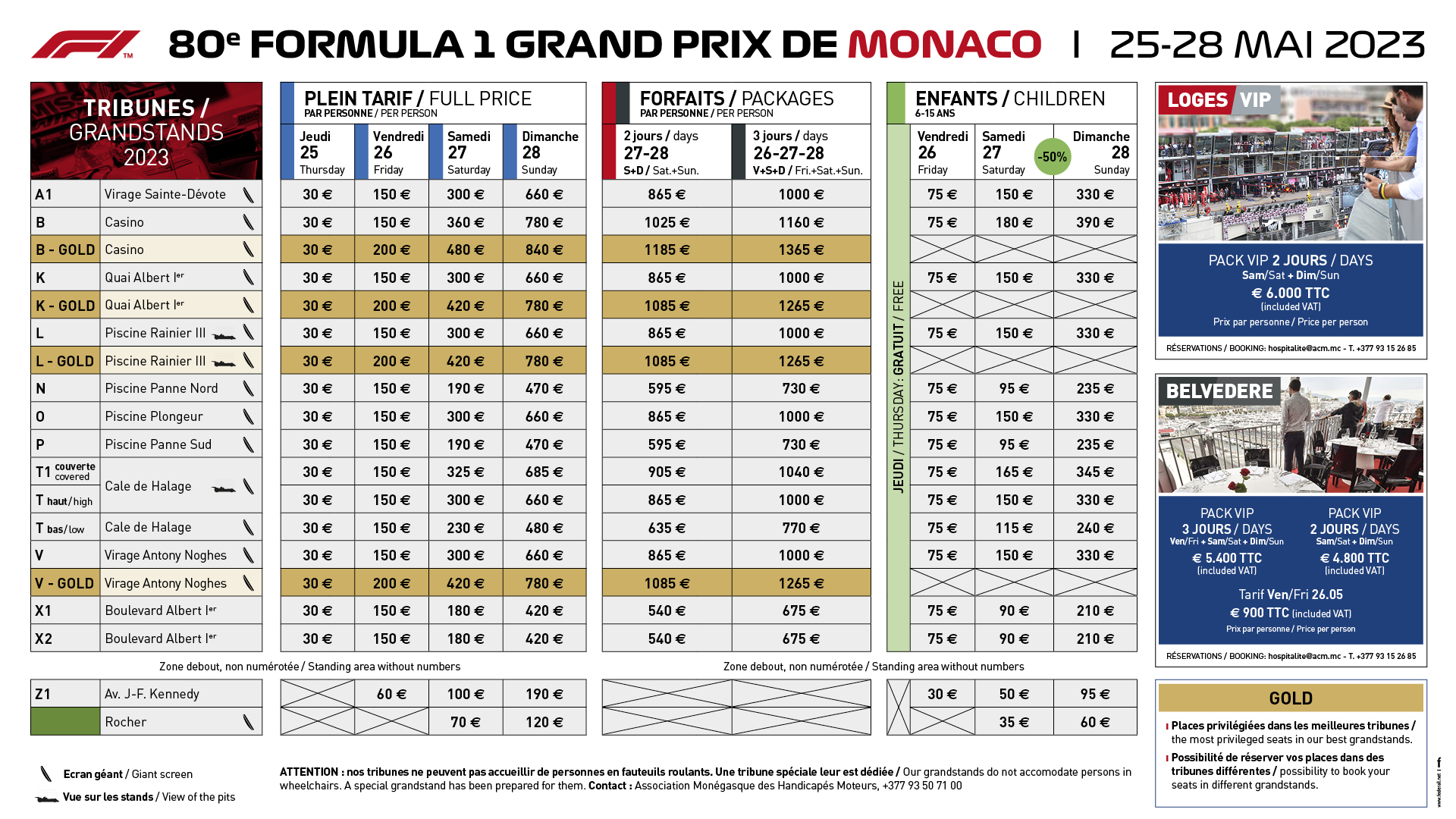
The Official Ticketing for the 80th Formula 1 Grand Prix de Monaco is now open. After the great vintage of 2022, which saw Sergio Perez triumph (Red Bull), the Automobile Club de Monaco invites you for a unique weekend from Thursday 25th to Sunday 28th May 2023 in the Principality of Monaco.
You can already book your seats in the Grandstands or in our “Hospitality” areas on the dedicated website www.formula1monaco.com or directly at the Official Ticket Office of the Automobile Club de Monaco (44, rue Grimaldi – Monaco).
In 2023, 4 series will be on the programme for these 4 days of competition: Formula 1, Formula 2, Formula 3 – which marks its return in Monaco – and Porsche SuperCup.
Discover our prices:
Formula 1 will continue to race in Monaco until 2025 after a new three-year agreement was finalised between the Automobile Club of Monaco (ACM) and Formula One.
Created in 1929 and included in the Formula 1 World Championship calendar since its creation in 1950, the race offering a unique challenge for drivers and a backdrop that is famous around the world.
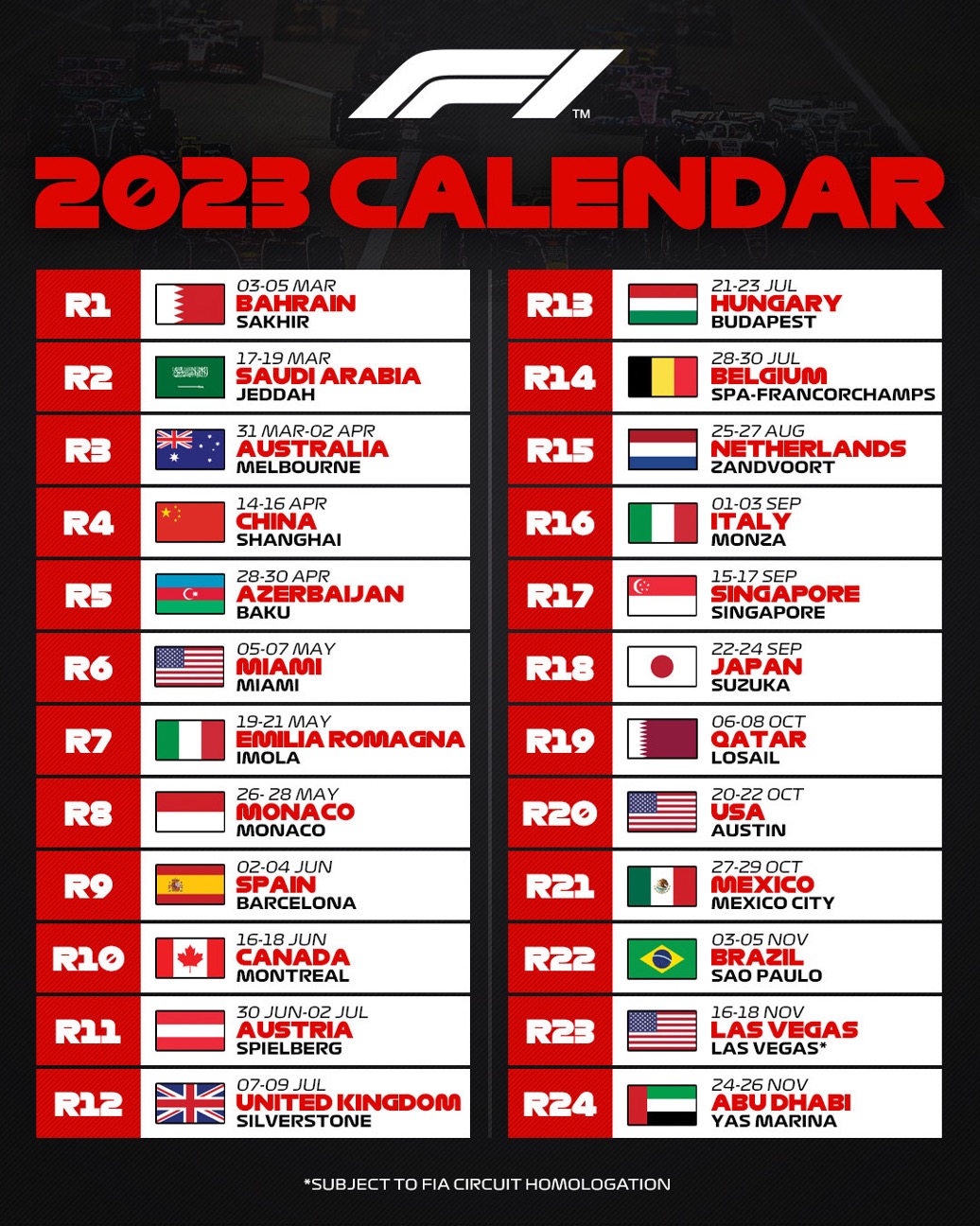
Monaco will stage the eighth round of the 24-race 2023 season, from Thursday 25 to Sunday 28 of May.
“I am pleased to confirm that we will be racing in Monaco until 2025 and excited to be back on the streets of this famous Principality for next year’s Championship on May 28,” said Stefano Domenicali, President and CEO of Formula 1.
“I want to thank everyone involved in this renewal and especially H.S.H. Prince Albert II of Monaco”, Michel Boeri, President of the Automobile Club of Monaco. “We look forward to being back next season to continue our partnership together. In the interest of the Formula One World Championship, and after several months of negotiations, we are proud to announce that we have signed a three-year agreement with Formula One, and likely to be renewed.”
The entries of the XXVth edition of the Rallye Monte-Carlo Historique (January, 24 / February, 01 2023) are now open.
The entry procedure is available by clicking the following link “Registration 2023“.
The closing date for the entries is Monday 07 November 2022 (Deadline for receipt of the complete file with payment).
The Supplementary Regulations of the Rallye Monte-Carlo Historique 2023 are also available in the Official Documents section, where the formalities for event participation are fully detailed.
The Organizing Committee of the 25th edition of Rallye Monte-Carlo Historique took special care in restoring five authentic concentration routes, from Bad Homburg, Oslo, London, Turin and Reims. Five itineraries… for a common destination: Monte-Carlo. And the rally route remains a series of famous special stages, all of them used every year by the World Championship event, the inaugural leg of WRC. There will again be many competitors entered, all of them ready to fight on these legendary roads along 17 Regularity Stages (SR) in order to win the trophy held by Belgian twins Philippe and Antoine Cornet de Ways Ruart, winners in 2022 in a 1965 Porsche 911.
The competitors will arrive in the Principality of Monaco, depending on their city of departure, on Friday January 27between 3:00 and 7:40 pm. The next day, Saturday January 28 from 7:00 am, the Classification Leg will start, with four SRs to be contested heading north to Valence, the prefecture of the Drôme department and once again the Host City for the event. As an appetizer, the copious “Briançonnet – Ubraye / SR1 / 9:20 am / 18,27km” will comprise Col du Buis (1196m) and Col de Laval (1100m) in the Ubraye valley, at a time of year when snow and ice are almost everywhere. Crews will then head for “Chaudon-Norante – Digne-les-Bains / SR2 / 10:35 am / 15,79km” and its illustrious Col du Corobin (1211m), followed by a mid-day time check on Place du Tampinet in Digne-les-Bains from 11:20 am. After this break, they will enter “Le Castellard-Mélan – Sisteron / SR3 / 12:00 pm / 33,34km” and its dreaded Col Fontbelle (1304m) followed by “Recoubeau-Jansac – Pennes-le-Sec / SR4 / 2:30 pm / 16,12km” via Col de Pennes (1040m) to end the purely sporting part of this Classification Leg. A final time check is scheduled at Crest (3:40 pm) in order to regulate crews before their arrival at Champ de Mars in Valence (4:30 pm).
Leaving Valence at 8:00 am on Sunday January 29, crews will head for Ardèche where Part 1 of the Common Leg will be staged. On the morning menu, a revised and modified version of the famous Moulinon stage, “Saint-Sauveur-de-Montagut – Saint-Andéol-de-Vals / SR5 / 9:00 am / 40,69km” via Col de Sarasset (825 m). Then hungry crews will stop in Antraigues-sur-Volane, in front of the famous “Remise”, to enjoy the notorious apple tart skilfully prepared by the Jouanny family. Another legendary stage will follow, “Burzet – Saint-Martial / SR6 / 11:20 am / 30,63km” via the Ray-Pic waterfall and Lachamp-Raphaël. As in previous years, the mid-day break will happen on Place du Marché in Saint-Agrève (01:00 pm) where a tasting session for local and regional products always comes at the right time. A significant burst of energy for the competitors, before heading for the high-altitude loop of “Saint-Bonnet-le-Froid / SR7 / 1:30 pm / 27,05km” and, since the previous edition, the Liberthe road which surprised many participants last year. To end the day in style, “Lamastre – Colombier-le-Jeune / SR8 / 3:05 pm / 14,15km” via Col de Saint-Genest (709 m), and as it has become customary these past few years, there will be a last stop before returning to Valence (5.10 pm) : “rallystic” seductions organized on the Farconnet Dock in Tournon-sur-Rhône at 4:20 pm, perfectly orchestrated by the Tournon City entertainment committee.
Direction Haut-Diois, on Monday January 30 from 08:00 am, still departing from Valence, for Part 2 of the Common Leg starting with “Valdrôme – La Piarre / SR9 / 10:10 am / 13,78km” via La Bâtie-des-Fonds – Source of the Drôme – and Col de Carabes (1261m), the natural border with the neighboring Hautes-Alpes department. A perfect link to the Savoyons through “Furmeyer – Barcillonnette / SR10 / 11:10 am / 14,86km” via Col d’Espréaux (1160m). The mid-day pause in Laragne-Montéglin (12:10 pm) will happen at the ideal time for competitors willing to rest a few minutes and recharge their batteries with some local sweets. Before embarking on “Eygalayes – Verclause / SR 11 / 12:50 pm / 36,89 km” including the ascents of Col Saint-Jean (1159m), Col de Pierre-Vesce (1056m) and Col du Reychasset (1052m) in the heart of the Baronnies area, never an easy task! To end this day, a return to the Diois massif is planned, with “Crupies – Saillans / SR12 / 02:35 pm / 23,71km” via Col du Gourdon (953m) and Col de la Chaudière (1047m) as justices of the peace! The last stop of the day is scheduled on Place du Champ de Mars in Crest with a time check from 3:40 pm before returning to Valence (4:30 pm).
On Tuesday, January 31, the start from Valence is scheduled at 07:00 am, heading for Drôme Provençale. This 3rd and last part of the Common Stage begins with “Saint-Nazaire-le-Désert – La Motte-Chalancon / SR13 / 8:30 am / 19,96km”, a monument revisited for the occasion with Col de Planlara (1037m ) to pass before continuing, at exactly the same altitude, with Col de Chamauche. The rest of the fight will happen through the timed stage of “Montauban-sur-l’Ouvèze – Laborel / SR14 / 10:05 am / 18,91km” in its classic version including Col de Perty (1302m). Last but not least, to end this long day heading back to the Principality, crews will take on La Colle Saint Michel between “Thorame-Haute – Le Fugeret / SR15 / 01:05 pm / 18,43km”. The final time check is scheduled on Place Neuve in La Turbie, from 03:30 pm before entering Parc Fermé in Monaco (4.00 pm).
A few short hours of rest will then be allowed before the start of the Final Leg (09:00 pm), scheduled for the last night of Tuesday January 31 to Wednesday February 1. On the menu, two famous stages: “Col de Braus – Lantosque / SR16 / 10:00 pm / 34,35km” and “La-Bollène-Vésubie – Moulinet / SR17 / 11:10 pm / 22,33km”. Crews will be expected on the finish line in Monaco Port Hercule around 1:10 am. Finally, in keeping with tradition, the Gala Night and Prize-Giving Ceremony will take place on the evening of Wednesday February 1, in Salle des Etoiles at Sporting Monte-Carlo. (Evening dress or dark dress required).
The exceptional sometimes tends to replicate! Following the huge success of its previous edition, and under the recommendation of the Organizing Committee at Automobile Club de Monaco (ACM), Rally Monte-Carlo 2023, the inaugural event of FIA World Rally Championship (WRC), will again settle down next winter in the Principality. More compact geographically, but still very selective, the rally route – with 50% of the itinerary being modified, compared to 2022 – will have new features and a high number of difficulties, thanks to a series of very demanding special stages in the departments of Alpes-Maritimes and Alpes-de-Haute-Provence.
After three days devoted to recce, from Monday January 16 to Wednesday January 18, it will be time for the shakedown session, scheduled for Thursday January 19 from 9:31 am. Reserved to Priority 1 drivers only, and closed to the public for safety reasons, it will use the Col des Banquettes road (744m) towards Peille, starting from Place Saint-Sébastien in Sainte-Agnès, the highest coastline village in Europe. A winding climb of 2.29km and a perfect road to make final set-up adjustments before the official start on the same evening, from 6.30 pm, in the sumptuous setting of Place du Casino in Monte-Carlo. On the menu for this very first “Turini” night session, two special stages for a total of 40.93km, including a brand new version of “La Bollène-Vésubie / Col de Turini” (SS1 – 15.52km – 8:18 pm), starting for the very first time from Camp de Millo, and a very pacy stage “La Cabanette / Col de Castillon” (SS2 – 25.41km – 9:11 pm) which, for the very first time in the history of the rally, will allow drivers to race through five passes in a row: Col de l’Orme (1000m) then Col de l’Ablé (1149m), Col de Braus (1002m), Col Saint-Jean (642m) and Col de Castillon (706m).
On Friday January 20, crews will be heading for the north of the Alpes-Maritimes department and the second day of racing will total 106.18km against the clock. With a loop of three special stages to be covered twice, and an intermediate stop for a regroup and change of tires in Puget-Théniers, this will be a tough cocktail of hardships! Starting with “Roure / Beuil” (SS3/6 – 18.33km – 09:14 am / 2:08 pm) to be run at the foot of the Mercantour National Park, via Col de la Couillole (1678m), then a demanding sequence consisting of “Puget-Théniers / Saint-Antonin” (SS 4/7 – 20.06km – 10:22 am / 3:16 pm) followed by “Briançonnet / Entrevaux” (SS5/8 – 14.70km – 11:25 am / 4:19 pm) via Col du Buis (1196m) and Val-de-Chalvagne. In other words, this 2nd leg promises to be lively!
Next on the menu are Alpes-de-Haute-Provence for the third day of racing on Saturday January 21, which will total 98,43km spread over five special stages. Starting with the 2020 version of “Malijai / Puimichel” (SS9/11 – 17.47km – 09:38 am / 2:08 pm) and continuing with “Saint-Geniez / Thoard” (SS10/12 – 20.79km – 11:26 am / 3:56 pm) via Authon and its dreaded Col de Fontbelle. Between the two loops, there will be a “tire” stop and mandatory regrouping in the heart of Digne-les-Bains, on recently renovated Place du General de Gaulle. Eventually, at the end of yet another day without service, crews will have to take on “Ubraye / Entrevaux” (SS13 – 21.91km – 5:59 pm), at night, via Route de la Clue along Ravin-de-Chalvagne.
Last but not least, for the final leg on Sunday January 22, four special stages totaling 68.98km are scheduled, still without assistance. Two well-known stages in the hinterland, in the north-east of Alpes-Maritimes, to be covered twice by all the remaining crews, and not limited to 50 competitors by the regulations, as in previous years, in order to thank amateur crews for their commitment over the past few years. They will all have to deal with the long version of a traditional stage, “Lucéram / Lantosque” (SS14/16 – 18.97km – 08:01 am / 10:40 am) and a couple of passes in the inaugural stage of this 2023 edition “La Bollène-Vésubie / Col de Turini (SS 15/17 – 15.52km – 09:08 am / 12:18 pm). This famous special stage, at the second pass, will serve as Power Stage. Crews will then return to Monaco around 2:30 pm to pass the finish line, the best of them heading then to the Prize-Giving Ceremony on Place du Casino.
Stages, lengths and timings are indicative, until publication of the official itinerary.
Monaco, July 22, 2022